


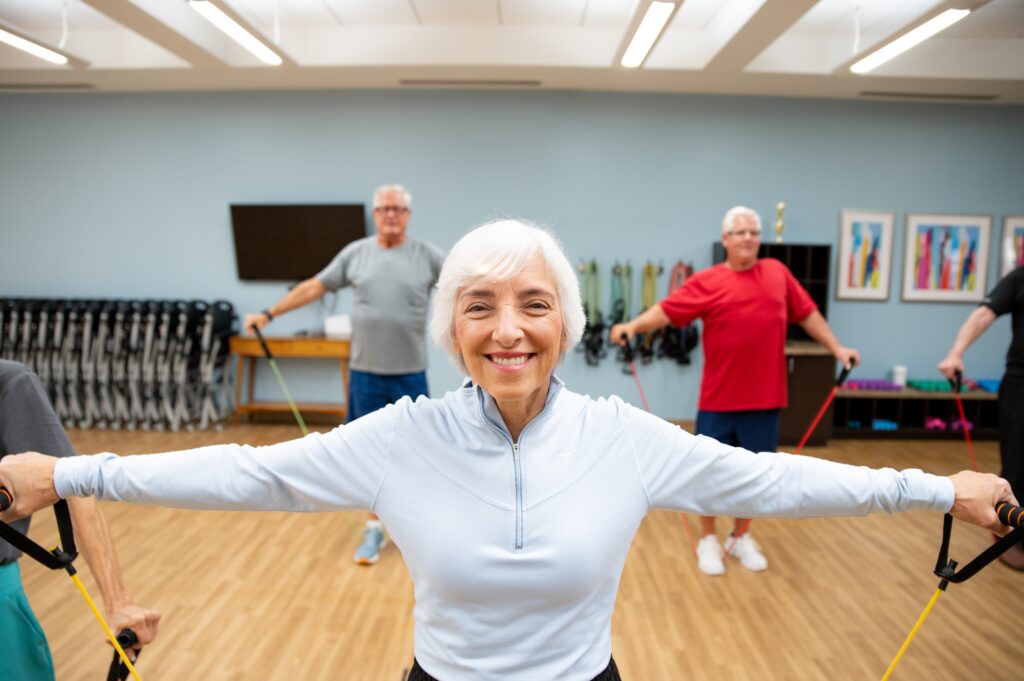
The most effective exercise routines include exercises that promote balance, mobility, and strength. Strength gives your muscles the power to hold a position or catch yourself. Mobility gives your joints the range to move freely, reach, bend, and turn. Balance ties the two together, using both to keep you steady while you move through daily life.
September is Healthy Aging Month – making it a great time to explore practical exercises in each category.
Balance Exercises for Seniors to Try
Balance exercises strengthen the stabilizing muscles and reaction time that help keep you steady. Here are a few to try this month:
- Single-leg stands: Holding onto something sturdy, slowly lift one foot a few inches off the floor and hold that position for 10 to 15 seconds. Keep your standing leg steady and your gaze forward rather than down at your feet. Lower your foot and repeat on the other side. This trains the small muscles that correct a shift in weight before it becomes a stumble.
- Heel-to-toe walk: Walk in a straight line placing the heel of one foot directly in front of the toes of the other. This builds coordination for walking on uneven ground.
- Weight shifts: Standing with feet hip-width apart, shift your weight slowly from one foot to the other without lifting your feet. This improves control during everyday movements like reaching for something on a shelf.
Mobility Exercises for Seniors to Try
Mobility exercises keep joints loose and reduce the stiffness that makes movement feel harder than it needs to be. Try incorporating these exercises into your routine:
- Seated marches with reach: Sit tall toward the front of a sturdy chair, feet flat on the floor. Lift your right knee toward your chest, and at the same time, reach your left hand down to meet it, letting your torso rotate slightly to follow the movement. Lower back down with control, then repeat on the other side. Do 8 to 10 reaches per side. This exercise loosens the hips and improves rotation through the spine.
- Ankle circles: Sit in a sturdy chair and lift one foot slightly off the floor. Rotate your ankle slowly in a full circle, 10 times clockwise, then 10 times counterclockwise. Lower your foot and repeat with the other ankle. This exercise keeps the ankle joint flexible, which directly affects walking gait and helps prevent the shuffling steps that raise fall risk.
- Shoulder rolls and arm reaches: Sit or stand tall. Roll both shoulders backward in a slow circle, up toward your ears, back, and down, for 8 to 10 rolls. Then reach both arms straight overhead, holding for 2 to 3 seconds before lowering, and repeat 8 to 10 times. This exercise loosens the shoulder joint and takes it through its full range.
Strength Exercises to Try
Strength exercises build muscle that supports every movement.
- Standing hip abduction: Holding on to something sturdy for support, lift your leg out to the side a few inches, then lower with control. Repeat 10 times per side. This exercise strengthens the outer hip muscles that stabilize the pelvis while walking.
- Bicep curls: Sit or stand tall holding hand weights, one in each hand. Bend your elbows to bring your hands toward your shoulders, then lower slowly. Repeat 10 to 12 times. This exercise builds arm strength for everyday tasks.
- Seated leg lifts: Sit tall in a chair, hands on the seat or armrests for support. Extend one leg straight out in front of you, hold for 2 to 3 seconds, then lower with control. Repeat 10 times, then switch legs. This exercise strengthens the quadriceps and hip flexors, the muscles most responsible for standing up, walking, and climbing stairs safely.
Always check with a doctor before starting a new routine.
How Friendship Village Makes it Easy to Keep Up
Our community members build balance, mobility, and strength through wellness classes led by instructors who design programming specifically for this stage of life. Options across our Sunset Hills and Chesterfield campuses include strength training, yoga, walking groups, and more – all on-campus. Schedule a tour to see our fitness facilities in person.
FAQ
How often should older adults exercise?
Adults 65 or older need a mix of aerobic, muscle-strengthening, and balance activities each week. According to the CDC, the specific benchmark is at least 150 minutes of physical activity weekly, including activity to strengthen muscles and improve balance.
Can seniors improve strength and balance even if they haven’t exercised in years?
Yes. According to the National Institute on Aging, it’s possible for most older adults to increase muscle strength with exercise, which can help maintain mobility and independence into later life. Starting at a comfortable level and progressing gradually produces the best long-term results.
Building balance, mobility, and strength together isn’t complicated. It just takes the right exercises and a consistent routine that’s easy to keep. Interested in our workout classes? Come see our wellness programming in person.